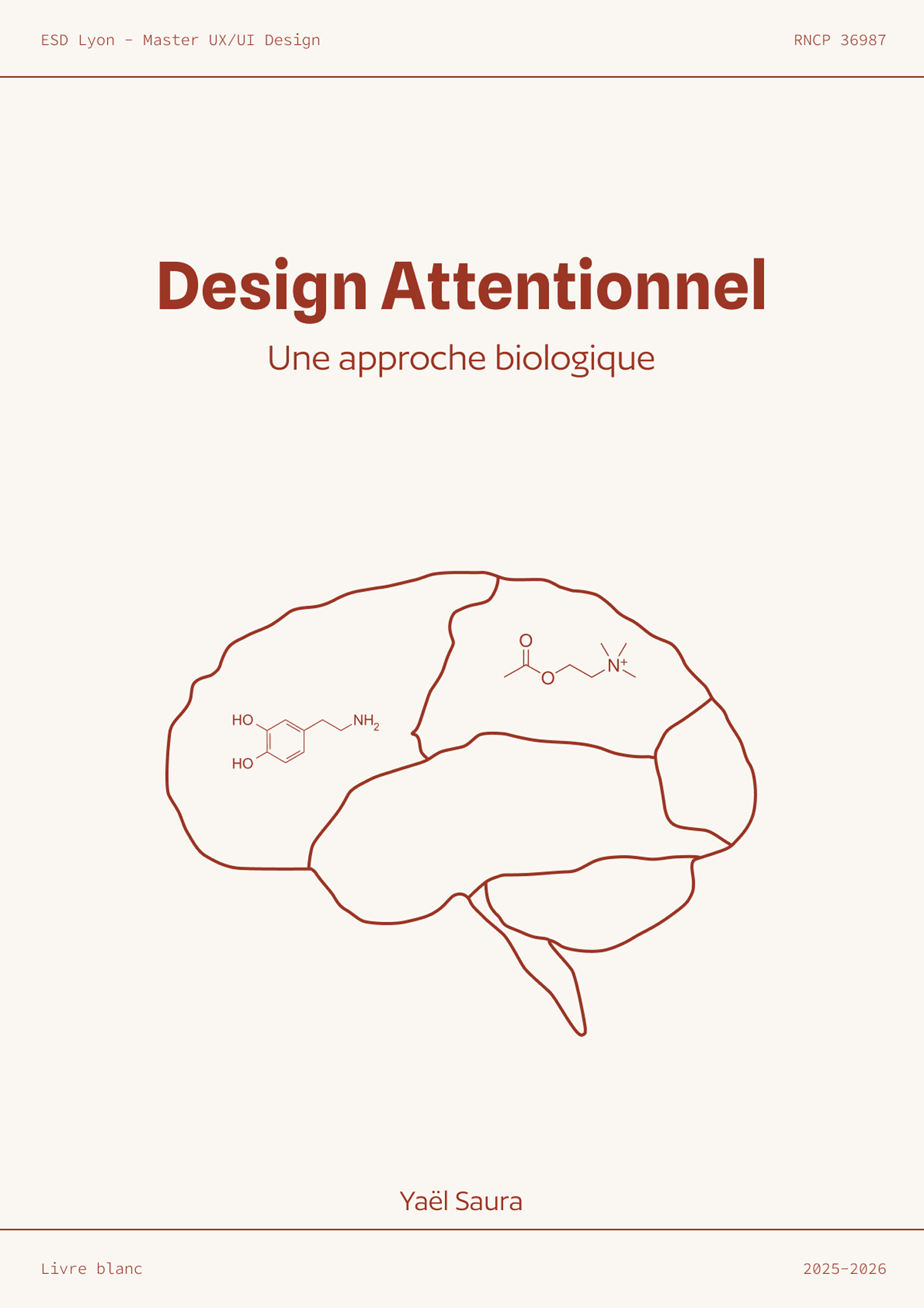
Attentional Design
What if we designed for the brain we actually have, not the brain we wish we had?
Quick facts.
PROJECT : White Paper
YEAR : 2025 - 2026
TYPE : Research, writing, editorial design
TOOLS : Figma, Google Scholar, PubMed
LANGUAGES : French (original) & English (translation)
STATUS : Published
that's it.
Digital interfaces don't just "compete for attention", they engage with the same biological systems that evolved to detect predators, novelty, and reward. Yet most UX research stops at clicks and engagement metrics, treating attention as an unlimited resource.
I wanted to bridge the gap between cognitive science and UX practice: a research-driven white paper that explains how interfaces interact with the brain's attention mechanisms, and what designers should do with that knowledge.
Built as a master's thesis, written as a publication: dual-level reading for both UX practitioners and cognitive science researchers, published in both French and English.
CONTENT.
01 — Introduction : Attention as an ignored resource
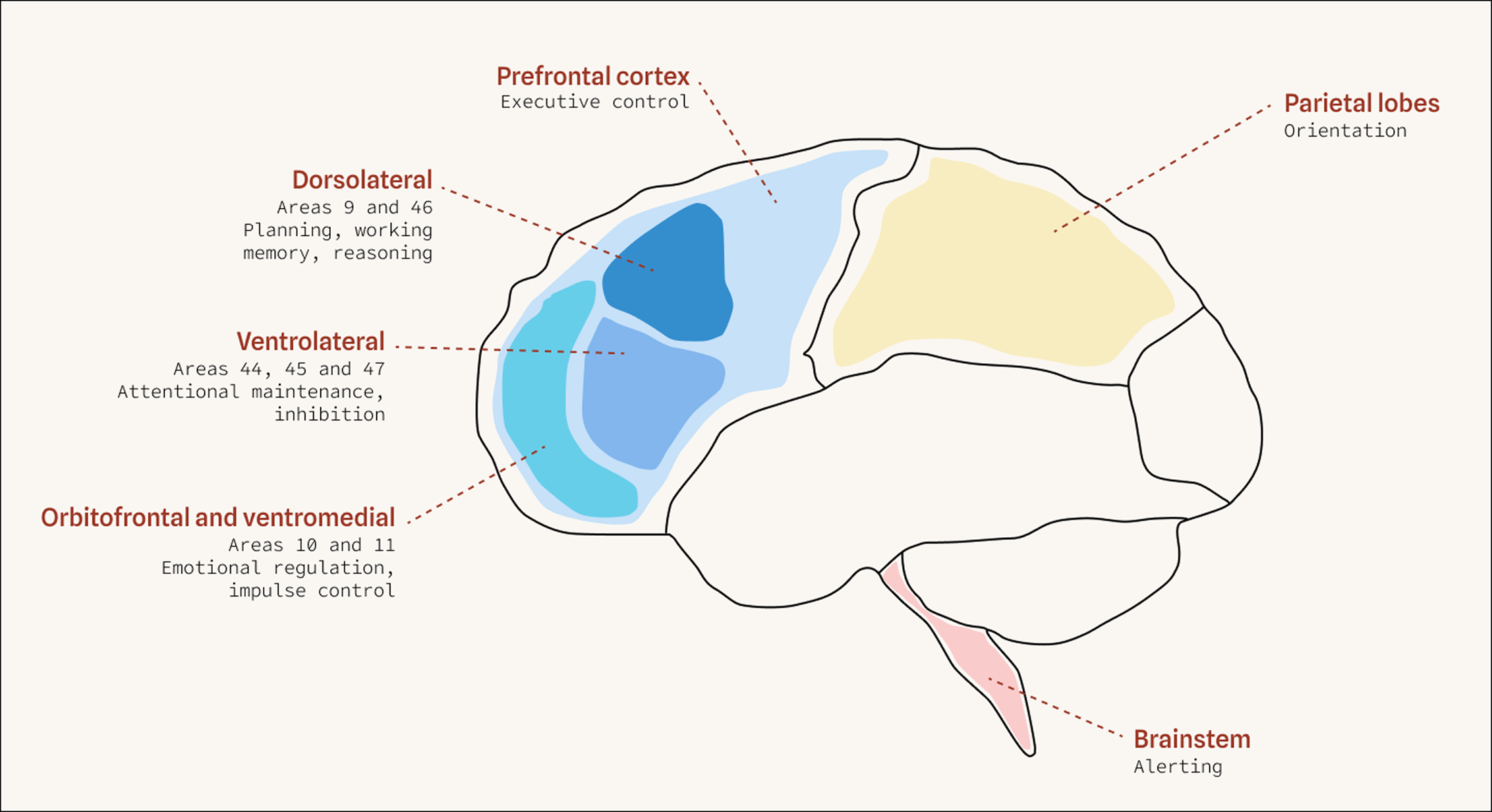
02 — The biology of attention : Brain networks and cognitive cost
03 — Interfaces that disrupt without intending to
04 — Interfaces that manipulate on purpose : Dopamine loops, dark patterns
05 — How the body and brain adapt : Embodied cognition, decision fatigue
06 — Toward a new design paradigm : Calm Technology & embodied research
07 — Conclusion : Design as an ethical choice

what i learned.
A biology degree turned out to be the best UX research training I never planned for. The methods overlap more than either field admits.
Once you understand what your interface does to a brain, you can't unsee it. Every notification becomes a small ethical decision.
Writing for two audiences at once (researchers and designers) was harder than the research itself. Dual-level reading isn't a feature, it's a discipline.
that's it.

